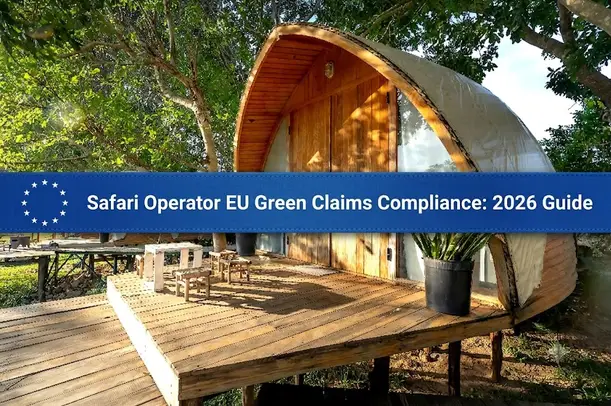
EU Green Claims Compliance for Safari Operators and African Lodges Selling to European Travellers
For African lodges and destination management companies, marketing the continent’s wild, untouched corners is standard. But if your marketing targets European travellers, the regulatory landscape has shifted. As we approach the September 2026 enforcement of Directive (EU) 2024/825, understanding the rules around **safari operator EU green claims** is crucial. Broad terms like “eco-friendly” or “carbon-neutral safari” are now heavily regulated. To maintain your European client pipeline and protect your brand from severe penalties, you must transition from creative marketing copy to rigorous, auditable operational evidence.
For years, safari marketing relied on a self-policed system. Slogans like “low-impact eco-lodge” and “community-first conservation” were standard website copy. Under the amended Unfair Commercial Practices Directive (UCPD) framework, these self-declared, unverified claims are prohibited when targeting consumers in the European Union. Regulators across EU member states are preparing to sweep websites using automated scanning tools. To work with European travel agents, tour operators, and online marketplaces, you must align your operational data with the strict requirements of the European Commission’s anti-greenwashing frameworks.
Does The Directive 2024/825 apply to safari operators?
Yes. If your lodge or safari company markets to travelers residing in the European Union, the **African lodge greenwashing directive** (Directive (EU) 2024/825) applies directly to you.
EU consumer protection laws apply based on the consumer’s location at the point of sale, not the physical location of the service delivery. If you advertise to EU consumers, your marketing must comply with these new standards.
By the enforcement deadline of September 27, 2026, several core marketing practices must change:
Ban on Generic Claims: Terms like “eco-friendly” or “sustainable” are banned unless your operations hold a recognized third-party certification (like the EU Ecolabel or a GSTC-accredited standard).
Ban on Offset-Based Carbon Claims: You cannot claim a stay or safari is “carbon neutral” or “CO2 compensated” if that claim relies on buying carbon credits.
Accredited Third-Party Verification: All environmental and social sustainability claims must be independently verified by an accredited third-party scheme before publication.
Secondary Liability for EU Agents: European tour agents are legally liable for the claims they publish. If they feature your lodge as “eco-friendly” without verification, they face fines of up to 4% of their annual turnover.
Why a Kenyan, Tanzanian or South African operator falls under EU jurisdiction
European consumer protection authorities enforce compliance through the channels that connect African operations to European travelers. The European Commission regulates the transaction at the consumer’s end, meaning your physical location does not exempt you.
The "consumer-targeting" test
Under EU case law, if a company outside the Union directs its commercial activities toward consumers residing in EU member states, those consumers are protected by the laws of their home countries.
Regulators evaluate several indicators to determine if your safari business targets EU consumers, such as quoting rates in Euros (EUR), translating website content into European languages, or running digital ad campaigns aimed at users located within the EU.
EU OTA distribution and marketplace liability
Online Travel Agencies (OTAs) like Booking.com and Expedia, along with European tour operators and wholesalers, are subject to strict marketplace liability rules under the EU green claims framework. Intermediaries cannot shield themselves behind self-reported questionnaires.
To mitigate their legal exposure, EU-based distributors are restructuring their supply chains. Organizations such as the Tanzania Tourism Board, Kenya Wildlife Service, and the Kenya Private Sector Alliance (KEPSA) have noted that European wholesalers are beginning to issue compliance mandates to local Destination Management Companies (DMCs).
The claims safari operators most commonly get wrong
Because safari marketing has historically relied on the romanticism of the African wilderness, it is heavily saturated with terms that are now high-risk under the new EU rules.
"Carbon neutral safari" — almost never substantiable as currently used
It is common to see packages marketed as a “100% Carbon Neutral Safari.” Typically, the operator calculates the fuel used by game-drive vehicles and bush planes, and purchases local carbon credits—such as forest conservation offsets in the Kariba or Chyulu Hills projects—to declare the trip “neutralized.”
Under Directive 2024/825, this practice is banned.
Forestry offsets cannot guarantee that the carbon sequestered will remain locked away for the required 100-year window.
To comply, you must change your copy.
NOTE
— Elke van Wyk, Operations Director at Sabi-Sabi Sands Game Reserve / Karongwe Portfolio (South Africa):
“The ban on carbon-neutral claims caught us off guard. We’ve been paying for local forestry offsets to market ‘carbon-neutral game drives’. Our German wholesalers have told us we must stop using that term immediately. We’re now rewriting all our copy to focus on direct emissions reduction data and solar grid capacity.”
"Community-owned", "community-benefiting" — what evidence is required
Social sustainability is a key pillar of safari marketing, but under the new EU green claims rules, social claims are subject to strict substantiation standards.
To make these claims, you must hold documented, auditable evidence of the governance and financial flows:
For “Community-Owned”: You must provide share registries, land title deeds, or legal trust agreements proving that the local community holds the majority equity or ownership of the land and assets.
NOTE
— Josphat Njuguna, Sustainability Director at Kibo Safari Group (Kenya):
“In Kenya, we used to talk about ‘supporting local communities’ by showing photos of school donations on our website. But under the EU directive, our European agents are asking for auditable records showing exactly what percentage of bed-night fees goes to the community trust, and how those funds are audited. If we can’t produce the ledger, they threaten to drop us from their 2026 brochures.”
"Conservation lodge" — when this triggers the directive
Calling your property a “conservation lodge” implies that the primary purpose and ecological effect of your business is the protection of biodiversity and habitat.
If you claim that your lodge actively protects wildlife, you must show:
If a lodge consumes significant amounts of ground water, runs inefficient diesel generators, and generates unmanaged plastic waste, it cannot claim to be a “conservation lodge” simply because it is located inside a conservancy.
“Eco-luxury” / “low-impact” — the most-flagged terms
The phrase “eco-luxury” is a primary target for automated compliance scrapers.
If you market a luxury property, you must avoid using “eco” as a prefix.
Audit Tool & Pricing
Not Sure if You Violate The Regulations?
Are you concerned that your safari website contains terms that will be flagged by European regulators? Do not wait for a cease-and-desist letter from an EU consumer protection authority or a compliance warning from your distribution partners.
Run the audit on your safari site to see flagged claims →

Evidence that does and doesn't satisfy substantiation
Under the EU green claims framework, the burden of proof rests entirely on the safari operator. You must compile a digital compliance dossier before publishing any claim.
Local certifications (Ecotourism Kenya gold, Long Run member, Fair Trade Tourism)
Many East and Southern African operators display local environmental certifications to show their credibility. However, to satisfy the directive, a sustainability label must be based on an independent, accredited third-party verification scheme aligned with international standards (such as the GSTC criteria).
Let’s evaluate how common African certifications fit into this framework:
1. Ecotourism Kenya Gold: This Eco-rating scheme uses clear criteria regarding environmental conservation, community involvement, and cultural preservation.
While these certifications are crucial, you must link each logo directly to your active certification certificate on the verifier’s public registry, showing the date of validity and the scope of the audit.
Carbon offset documentation — what EU regulators now reject
If you continue to advertise carbon-offset programs on your website, you must understand what EU regulators now reject:
Rejected: Certificates of carbon credit purchases from voluntary market registries (like Verra or Gold Standard) used to claim that a guest’s stay or flight has been “offset” or “neutralized.”
Rejected: Generic claims that buying carbon credits makes your operation “carbon neutral.”
Accepted: Direct disclosures of operational greenhouse gas emissions (Scope 1 and Scope 2) in metric tons or kilograms of CO2e per guest-night, calculated using the Greenhouse Gas Protocol.
Accepted: Clearly stating: *”We purchase carbon credits to support local forest conservation in the Chyulu Hills.
Special considerations for operators with EU-based agents and tour wholesalers
If your primary booking pipeline relies on partnerships with inbound tour operators and wholesalers based in Germany, the UK, the Netherlands, Switzerland, or France, your business is highly exposed to the indirect effects of Directive 2024/825.
European tour wholesalers are “traders” under EU consumer law. If a German wholesaler features your lodge in their catalog and describes it as an “eco-paradise,” they are legally making that claim to their retail clients.
This creates several operational realities for African operators:
The “Compliance RFP”:Wholesalers are updating their annual contract renewals. You will be required to sign compliance clauses stating that all sustainability claims made in your marketing collateral are fully substantiated.
A compliance pathway for operators with limited compliance budget
For many family-owned safari operators, boutique tented camps, and local mobile safari companies, the administrative cost of compliance can feel overwhelming. You can achieve full compliance by executing a low-cost, systematic pathway.
Here is a simple-step compliance pathway designed for limited budgets:
Perform a “Simple Copy” Audit scan:Review your website from the report generated and delete all generic sustainability claims.
Strategy consultation
Compliance Guidance to Hotels and Tour Operators
Are you an African lodge owner or DMC looking to align your operations and marketing with the upcoming EU regulations? PurpleGiraffe’s Nairobi-based team offers direct, practical support to build your compliance dossiers and secure your European trade relationships.
FAQ's
Does the EU green claims directive apply if our company is registered in Kenya or Tanzania?
Yes. If your business actively markets to and targets consumers residing in the European Union (e.g., through rates in Euros, targeted ads, or partnerships with European wholesalers), you must comply.
EU regulators enforce consumer protection rules based on where the consumer is targeted, regardless of the physical location or registration of the operating company.
Can we still offer carbon-offset options to our guests?
Yes, but the marketing copy must change. You can continue to offer guests the option to fund local reforestation or cooking stove initiatives.
However, you are strictly prohibited from claiming that these payments make their stay or game drives “carbon neutral” or “CO2 compensated.” The transaction must be marketed as a voluntary conservation contribution, and you must state that it does not neutralize the carbon footprint under EU law.
What is the role of the Kenya Wildlife Service (KWS) in compliance?
While the KWS is a regulatory body for wildlife management in Kenya, it does not enforce EU consumer laws.
However, formal conservation partnerships and lease agreements verified by the KWS represent critical primary evidence in your substantiation dossier if you make claims about supporting wildlife conservation or protecting natural habitats.
How do EU regulators audit non-EU websites?
National competent authorities in EU member states use automated web-scraping software to sweep the internet for generic or non-compliant environmental terms.
If they identify a non-compliant claim on a website targeting their citizens, they can initiate action by warning EU distribution partners, issuing fines to European sales agents, or forcing OTAs to remove the listing from their platforms.
Next steps
The enforcement timeline for Directive (EU) 2024/825 is locked. By September 27, 2026, every environmental and social claim made on your website, booking paths, or brochures must be fully verified and documented. Waiting until the deadline is a high-risk approach, as certifying bodies are already facing audit backlogs.
To protect your booking pipeline and ensure your marketing stands up to regulatory scrutiny, take action today:
1. Scan your digital channels using our web scanner to identify flagged terms.
2. Purge generic claims and offset-based carbon neutrality statements.
3. Assemble your primary evidence into a digital compliance dossier.
4. Partner with a local specialist to audit your operations and verify your claims.